Run Claude Code in Depot sandboxes
Run Claude Code cloud sessions in Depot sandboxes through Claude's web, desktop, or mobile interface. Depot starts and manages the runner for you. View run status, timing, and failure details in your Depot dashboard.
How it works
A Claude Code self-hosted environment routes cloud sessions to runners on compute you choose.
Anthropic provides the Claude models and manages your conversation and session queue.
Depot creates a sandbox and starts a Claude Code runner inside it. The runner starts your session, where Claude Code runs the agent loop and tools. Claude Code connects to Anthropic for model responses and session updates.
What's the difference between Claude Code and Claude Managed Agents on Depot?
- Claude Code: Use Claude's web, desktop, or mobile interface for coding tasks. Depot runs the agent loop and tools.
- Claude Managed Agents: Build agents for applications or automated workflows. Anthropic runs the agent loop and Depot executes commands and file operations. Follow the Claude Managed Agents guide.
Get started
Prerequisites
Before you start, you need:
- A Depot account with the Owner role in your Depot organization.
- A Claude Team or Enterprise plan with self-hosted environments enabled.
- An environment key from a Claude Code self-hosted environment. Create the environment and copy its key in Cloud environments settings.
Connect Claude Code to Depot
- Open Settings > Connections > Agent providers in Depot and select Claude Code.
- Paste your Claude Code environment key into Environment secret.
- Click Connect.
Depot shows Connected to Claude Code and the Environment pool ID when the connection succeeds.
Depot keeps your environment key outside the sandbox. The sandbox receives a single-use credential to register its runner.
Choose a sandbox size
The default sandbox size is 4x16 (4 CPUs, 16 GB memory). To change the sandbox size, open Settings > Managed Runs and click Run settings for the connection. In the Sandbox table, select a Size in the Default row and click Save. See sandbox sizes for available sizes, billing, and when changes take effect. To run on ARM64 instead of x86-64, select arm64 under Sandbox architecture in the same section. See sandbox architecture for what changes. To take the Depot CI run controls away from runs, set Depot API token role to Read-only in the same section. See limit the CLI to reading. To start runs without Depot Cache credentials, turn off Depot Cache in the same section and click Save. See turn off Depot Cache for runs.
Authorize GitHub access
Each person who wants to start sessions must connect their own GitHub account to Claude.
Before you connect your account, an organization Owner must enable the GitHub connector for your Claude organization.
- Open GitHub Integration in Claude.
- Connect your own GitHub account if it isn't already connected. Use an account that has access to the repository you want to work on.
- Follow GitHub's prompts to authorize the connection.
Start a Claude Code session
- Open Claude Code on the web or the Code section in the Claude desktop or mobile app.
- Click the environment name (the first control below the message box) to open the environment selector.
- Find the environment you connected to Depot under Self-hosted environments and select it.
- Click Repo and choose the repository you want to work on.
Now you can send Claude a task for the selected repository. For example: "Read this repository and explain how to run its tests." Claude's response appears in the same conversation.
Verify your run in Depot
Open Managed Runs in your Depot dashboard and choose Claude Code in the provider filter to see your runs, newest first. You can also filter by status.
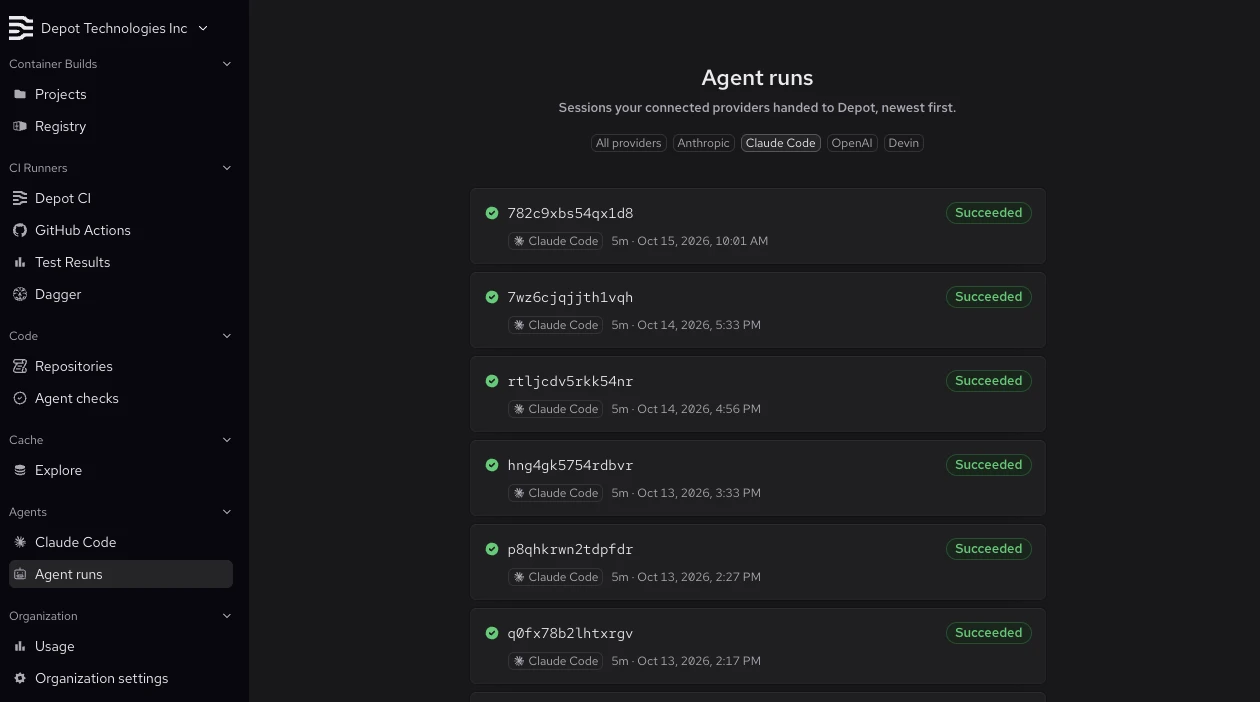
Select a run to see its status, duration, and steps. Each step also shows its duration and its log, and the setup script step shows the script's output. If the run failed, a banner shows the reason.
The Agent panel shows the sandbox ID. The Outputs panel lists the files the run saved, which you can download. See Save files from a run.
Use Open in Claude Code to return to the conversation when the link is available.
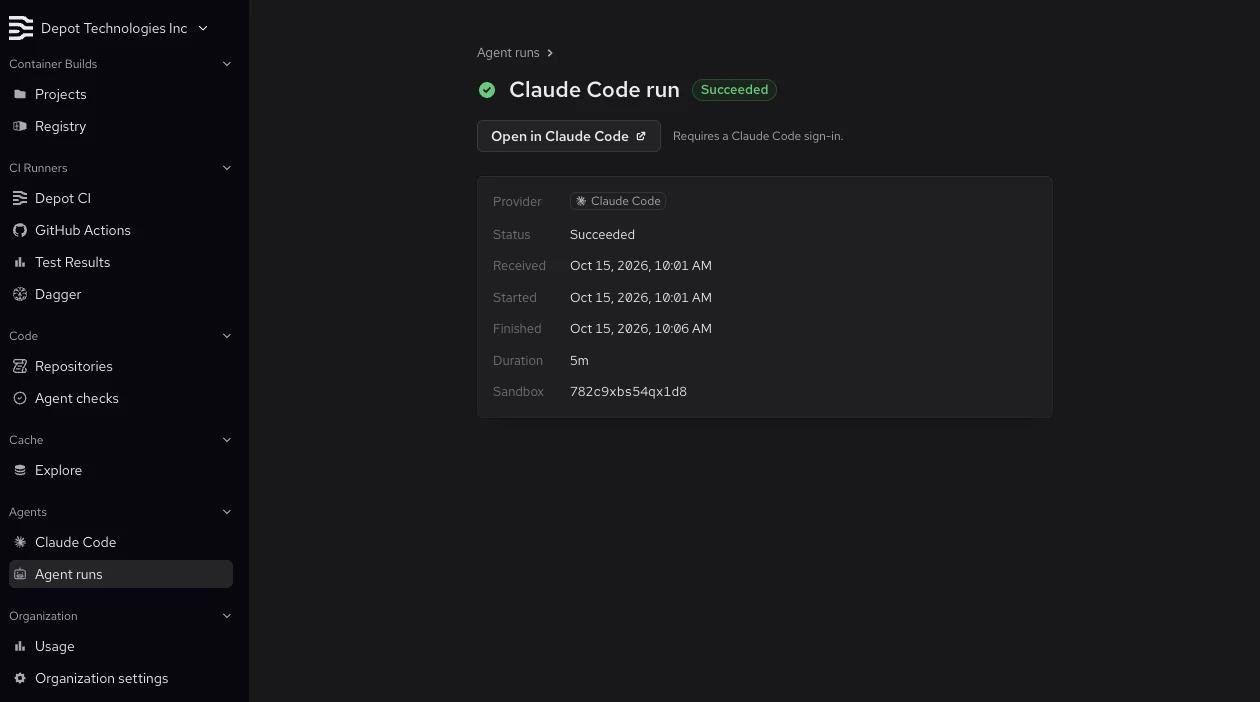
From the run page, organization owners can stop a run that's still working. See Stop a run.
What's next
With the connection working, give Claude Code a larger repository task: implement a feature, investigate failing tests, or prepare a refactor. The work runs on Depot without using your laptop's CPU or memory, and you can return to the conversation with follow-up instructions.
Continue working by sending another message in the same Claude Code conversation. If the session needs a new sandbox, Depot restores the latest available workspace snapshot. See Session continuity for details and limitations.