Updates and new features

16 NOV, 2026

The Container Layer Cache value in usage CSV exports and the GetUsage and GetUsageReport APIs now reports your organization's total storage across all projects, averaged over the period. Before this change, organizations with more than one project saw the average of their projects' caches instead, which was lower than the storage they were billed for.

Invoices are unchanged. Billing already used the organization total, and the reported value now follows the same calculation. It can still differ slightly from an invoice, for example when your billing period does not line up with the calendar month you exported. Past months are recalculated too, so a CSV you download now for an earlier month can show a higher Container Layer Cache value than one you downloaded before this change.

The storage section of the Usage page now also says that each value is your organization's total across all projects, averaged over the month.
16 NOV, 2026

Depot CI now automatically cancels unfinished jobs from an original merge-group execution when GitHub invalidates the group.

Completed jobs and their GitHub checks keep their results. Independent runs on the same commit SHA and newer workflow reruns are preserved, including failed results. Merge groups destroyed with reason merged or dequeued don't trigger cancellation.

Existing merge_group workflows use this behavior without additional triggers or concurrency settings. See merge queue behavior for details.

13 NOV, 2026

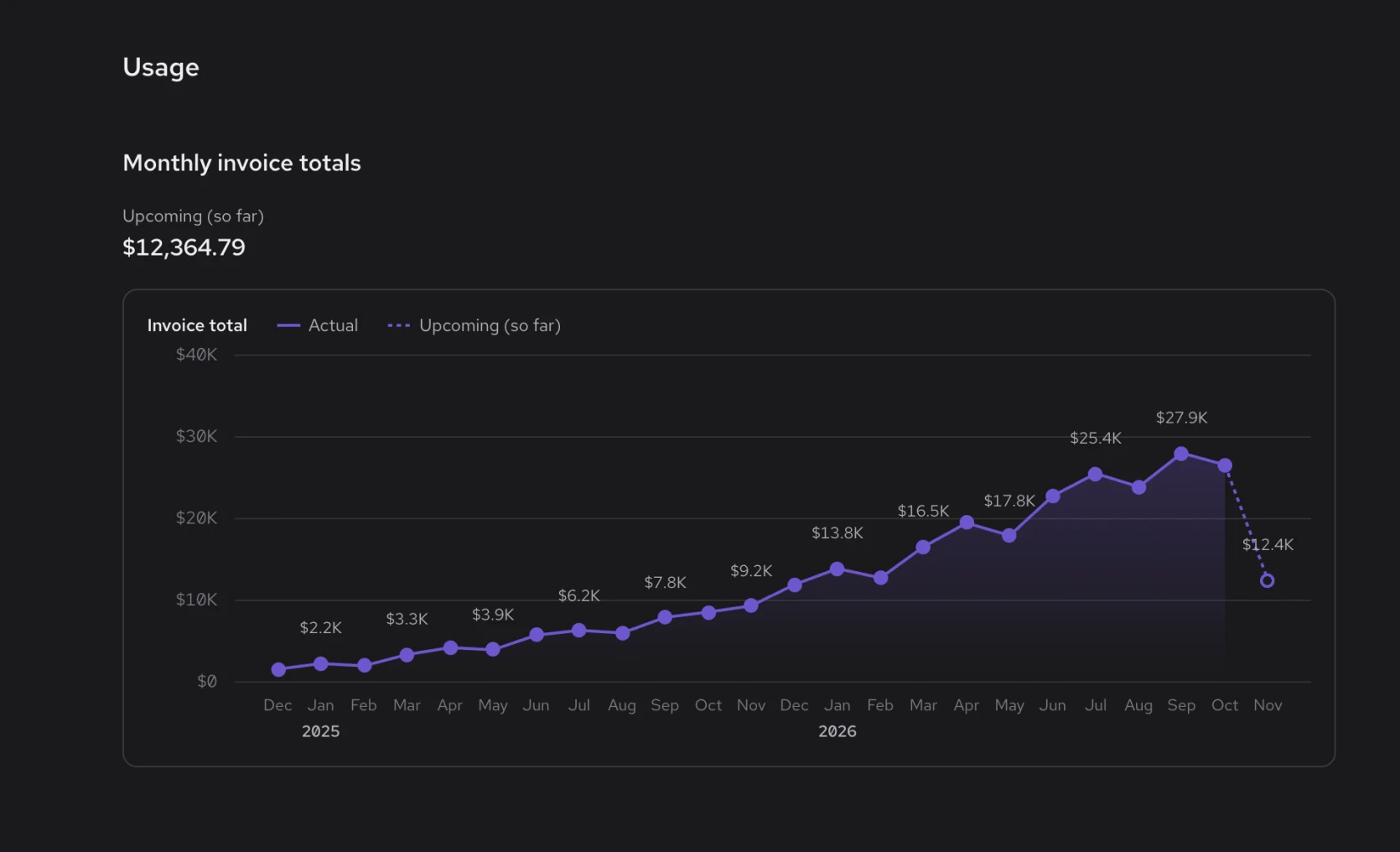
Monthly and annual customers with Stripe invoice history now have new spending charts in Billing & usage settings. Organization owners can view monthly spending charts covering the past 24 months, click a chart point for an invoice breakdown, or download PDFs directly from Invoice history.

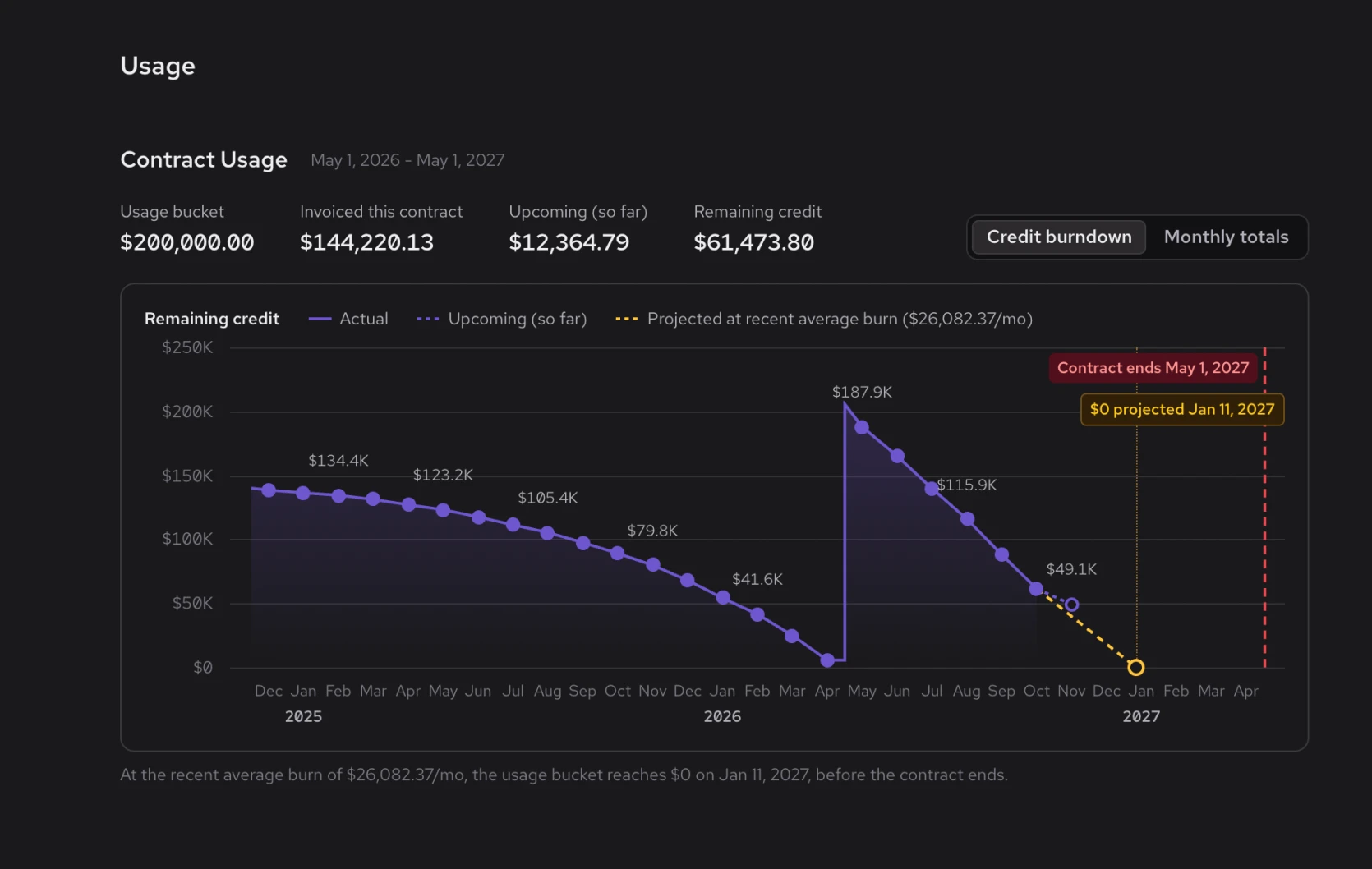
Annual contract customers can also track usage-bucket credit across renewals and top-ups, with an estimated run-out date based on recent average invoice totals.

Monthly invoice totals chart with example data, showing past invoices and an upcoming invoice estimate.
Monthly invoice totals are available to both monthly and annual customers. Example data shown.
Contract usage summary and credit burndown chart with example data, showing a credit increase at renewal, monthly usage, and a projected depletion date.
Annual contract customers can switch between credit burndown and monthly totals. Example data shown.

12 NOV, 2026

You can now connect Depot Checks 4 and Depot Checks 5 to give Depot CI more capacity to publish job status to GitHub. Each app adds its own installation rate limit, which can reduce check update delays for organizations with high CI volume.

If you've already connected the first three apps, open Settings > Connections > GitHub Checks and click Connect Depot Checks 4. Give it access to the same repositories as your other checks apps, then return to connect Depot Checks 5.

Check names stay the same, and no workflow changes are needed. Before connecting, review the GitHub checks setup guide, including the required check source settings and rate limit caveats.

10 NOV, 2026

Depot CI logs no longer expire after 14 days. We now keep them indefinitely, so you can investigate older runs and compare builds over time.

Sandbox logs are also retained indefinitely and can be retrieved after a sandbox stops through the Sandbox SDK. Use sandbox.logs.tail() to retrieve recent records, sandbox.logs.fetch() to query a time range, or sandbox.logs.stream() to follow live output.

See the announcement post for a code example and more about the new log platform.

05 NOV, 2026

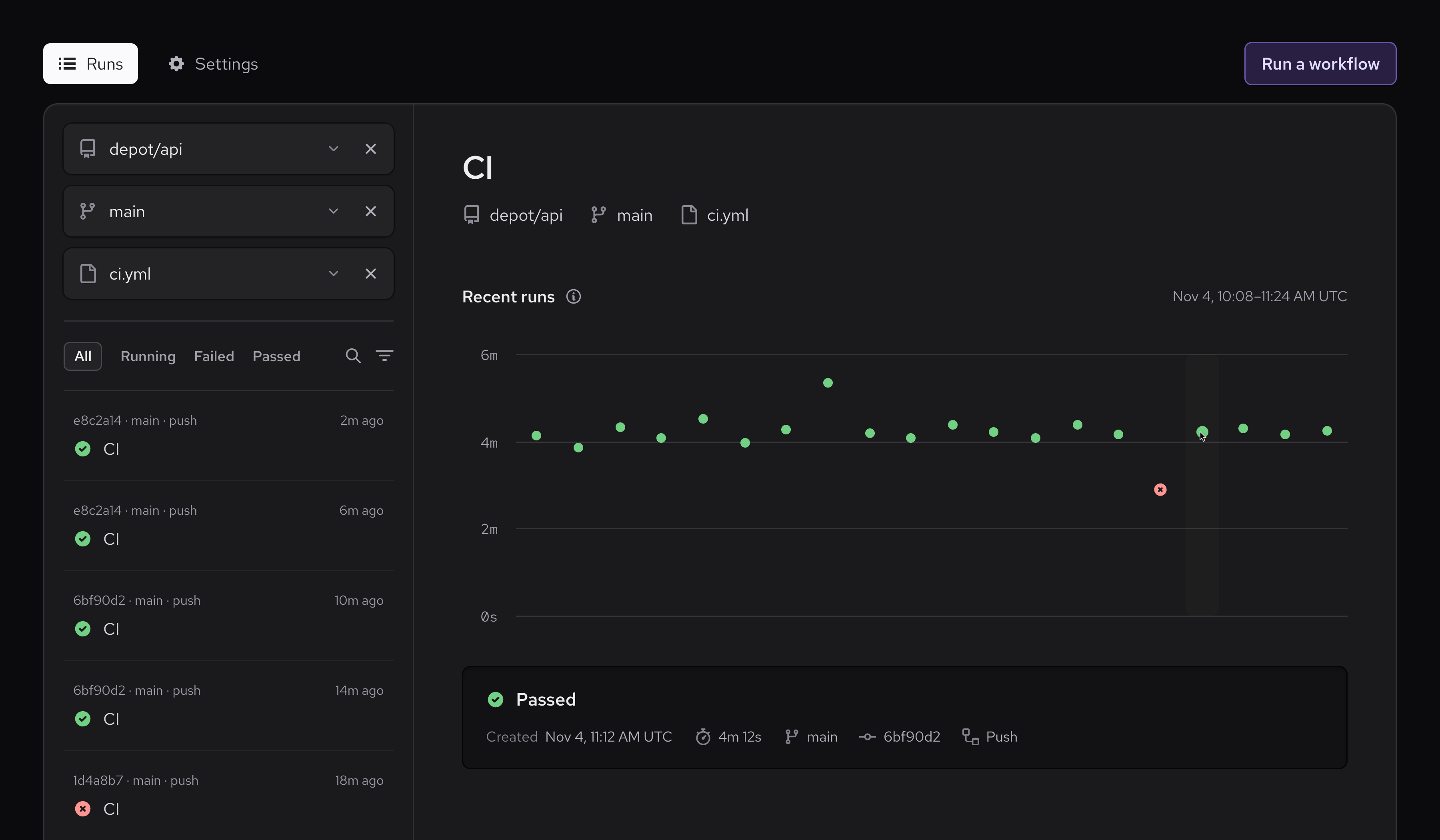
The Runs view in Depot CI now includes repository, branch, and workflow overviews. Select a repository, then narrow by branch or workflow. The sidebar shows runs for that selection. Open a run to inspect it while keeping your filters.

From a run, use the workflow link in the breadcrumb to browse other runs of the same workflow.

Workflow pages include a duration chart for comparing runs. Select a point to open that run.

Depot CI with depot/api, main, and ci.yml selected, recent runs in the sidebar, and a workflow duration chart

04 NOV, 2026

Updates and new features for Managed Agents:

  • Managed Agents now runs Amp threads. Create an orb provider in Amp's Settings > Orbs, then paste its token into Settings > Connections > Agent providers in Depot. Each orb runs the agent's tools in a Depot sandbox with the connection's run settings, and paused orbs keep their files. See the Managed Agents - Amp docs for setup.

  • Runs can now use arm64 sandboxes. Choose amd64 or arm64 in each provider connection's run settings under Settings > Managed Runs. This works with every provider.

  • Runs can now start from your own sandbox image. To start with your toolchains and dependencies already installed, build the image as a Depot snapshot in your organization's registry. Then choose it in the connection's General section under Settings > Managed Runs.

    • Claude Code connections can also use a different sandbox image and setup script for each repository. Runs on any other repository use the connection's image and script.
  • You can now turn off Depot Cache per provider connection. Depot Cache is still on by default. Turn it off for a connection with the Depot Cache switch in the connection's run settings. Runs on that connection then start without cache credentials.

  • OpenAI and Devin runs can now use your organization's MCP servers. Devin needs a one-time step in Devin's settings first. See the Managed Agents - Devin docs for details.

  • The Depot CLI is now signed in as your organization in runs from every provider. To give runs more access, such as starting container builds, add your own token as a run secret named DEPOT_TOKEN. To give runs less access, set the connection's Depot API token role to Read-only. The CLI can then read CI runs, jobs, logs, and test results, but can't start, cancel, or rerun CI runs.

See Managed Agents for setup and limits.

30 OCT, 2026

The project Builds page now defaults to the last seven days instead of loading the project's entire build history, making the page load faster for projects with long build histories. Open Projects in the Depot dashboard and select a project to view its build history. Use the date control in the Started column to choose the last 24 hours, seven days, 30 days, all time, or a custom range.

30 OCT, 2026

You can now connect Depot Checks 3 alongside Depot Checks and Depot Checks 2 to give Depot CI more capacity to publish job status to GitHub. The additional app can reduce check update delays for organizations with high CI volume.

If you've already connected the first two apps, open Settings > Connections > GitHub Checks and click Connect Depot Checks 3. Give it access to the same repositories as your other checks apps.

Check names stay the same, and no workflow changes are needed. Before connecting, review the GitHub checks setup guide, including the required check source settings.

29 OCT, 2026

The Managed Runs page now shows run details, including step durations and logs. Filter runs by provider and status, and select a run to investigate failures. Organization owners can also stop active runs.

Download saved files from the Outputs section after a run finishes. To make files available, have the agent save them to /workspace/outputs/.

Each Managed Agents connection now has its own run settings, in one place under Settings > Managed Runs. They cover:

  • Run secrets, including secrets that Depot sends only to hosts you list. Those secrets never enter the sandbox.
  • A setup script.
  • GitHub access through Depot's Code Access app.
  • MCP servers that runs can use.

In runs from Claude Code and OpenAI connections, the depot CLI is now signed in as your organization, so the agent doesn't need its own Depot token.

See Managed Agents for setup and limits.

22 OCT, 2026

Depot CI now supports on.pull_request_review_comment triggers. Run workflows when someone creates, edits, or deletes a comment on a pull request's diff. Use types to select the activities that trigger your workflow:

on:
  pull_request_review_comment:
    types: [created, edited]

Without types, all three activities trigger the workflow. Add the workflow to .depot/workflows/ on your repository's default branch to activate it. Runs use the pull request's merge ref, and the comment is available through github.event.comment.

See Pull request review events for event details and token and secret restrictions.

20 OCT, 2026

Depot CLI v2.102.24 adds depot build cancel for container builds. Cancel one or more builds by ID, or select all running builds in a project.

depot build cancel <build-id> <another-build-id>

Use --all-running --project <project-id> --dry-run to preview a bulk selection. Remove --dry-run to confirm cancellation interactively, or add --yes for scripts. Cancellation is asynchronous, so a successful request does not mean the build has already stopped.

The command requires an organization API token supplied through DEPOT_TOKEN or --token. See the container build cancellation reference for permissions and options.

20 OCT, 2026

Depot CI now includes job errors, step summaries, and artifact names and sizes in completed GitHub checks. Errors, warnings, and notices from workflow commands appear as annotations. Annotations that reference a file path and line number appear inline on pull request diffs.

You can review failures and workflow-generated reports directly in GitHub, then follow the links to the Depot dashboard for full job details and artifacts. Existing workflows use the new output automatically.

See GitHub check output for details and limits.

19 OCT, 2026

You can now connect the Depot Checks and Depot Checks 2 GitHub Apps to give Depot CI more capacity to publish job status to GitHub. Each app provides additional API capacity, reducing check delays for organizations with high CI volume.

Connect the apps from Settings > Connections > GitHub Checks in your Depot organization. No workflow changes are needed.

See the GitHub checks setup guide to get started.

19 OCT, 2026

Usage CSV exports now include a Sandbox compute (Depot CI) section with repository, workflow, runner, attempt count, elapsed minutes, and billed vCPU-minutes. You can compare workflow usage without assembling the data from individual runs.

Open the Usage page, select a month, and click Download CSV beside the month picker. Depot CI usage history is available from May 22, 2026; exports that overlap that date identify the partial history.

15 OCT, 2026

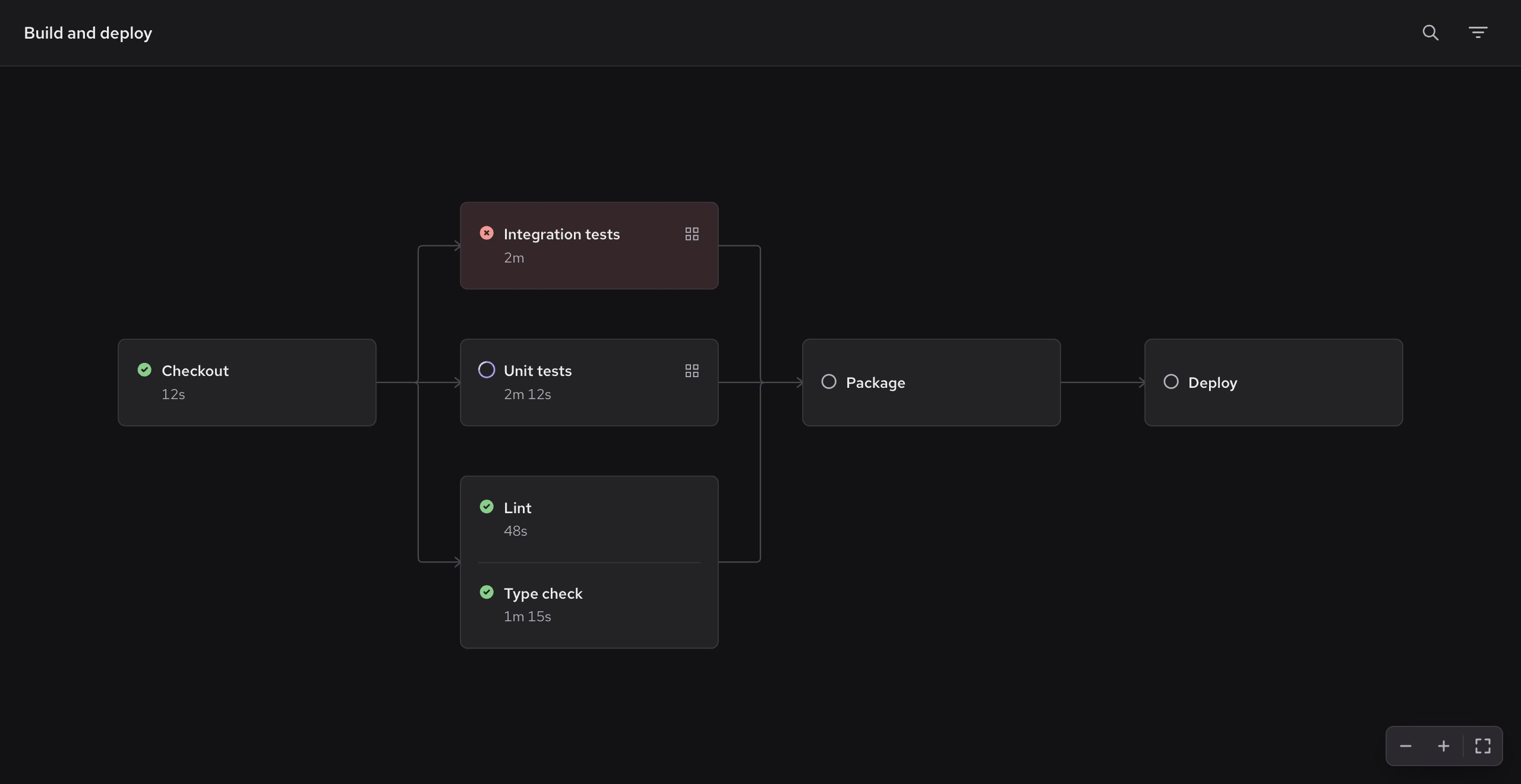
Depot CI now has a graph view for workflow runs, making it easier to follow job dependencies and investigate failures in complex workflows.

Depot CI graph showing Checkout, test groups, Package, and Deploy jobs

Open a workflow run and select Graph above the jobs list. You can also search for jobs in either view.

13 OCT, 2026

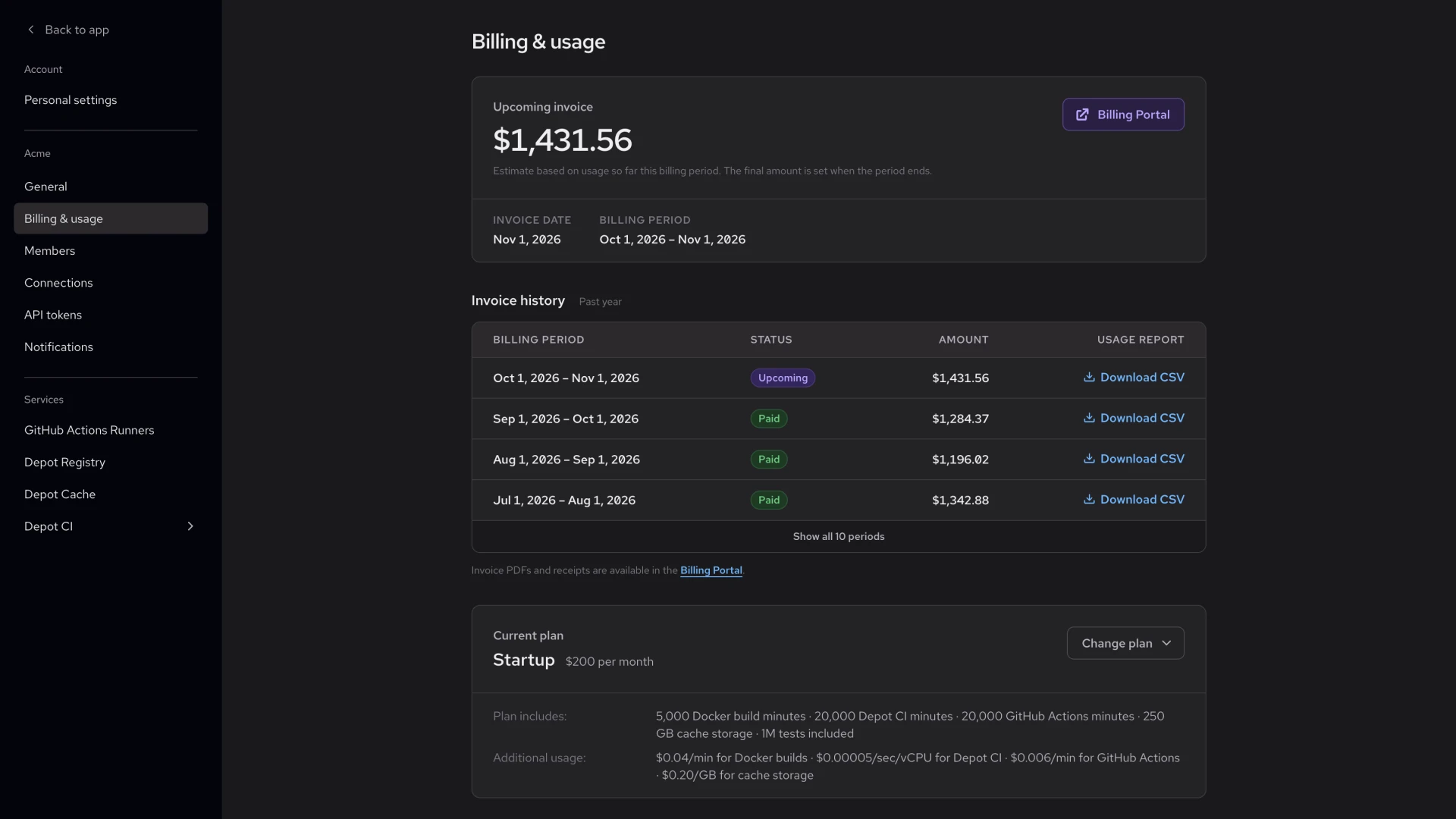
The Billing & usage settings page now shows your upcoming invoice amount and a history of past invoices.

Billing & usage settings showing an upcoming invoice amount with its invoice date and billing period, an invoice history table with status, amount, and Download CSV columns, and a current plan summary

The upcoming invoice is an estimate based on your usage so far in the current billing period, shown with the invoice date and billing period. Invoice history lists each billing period from the past year with its status and the amount paid. Click Download CSV on any row to get the usage report for that period. Invoice PDFs and receipts are available in the Billing Portal.

Your current plan now appears as a summary with its included usage and additional usage rates. Click Change plan to compare plans.

13 OCT, 2026

The Depot dashboard now supports Brazilian Portuguese, French, Japanese, Korean, and Simplified Chinese, alongside English. You can review builds, check GitHub Actions runs, and manage settings in your preferred language.

The dashboard follows your browser's language preferences by default. To choose a different language, open the organization menu at the top of the sidebar and select Language. Depot remembers your choice in that browser.

Read the localization announcement for details.

06 OCT, 2026

Press Cmd+K on macOS or Ctrl+K on Windows and Linux to find and open top-level sections of the Depot dashboard, such as Projects, Depot CI, GitHub Actions, and settings.

06 OCT, 2026

In Depot CI, github.event.workflow_run.name contains the triggering workflow's YAML name, not run-name. Without a name, it falls back to the workflow's repository path, as in GitHub. path now contains the repository path, such as .depot/workflows/ci.yml. A new basepath field contains the filename, such as ci.yml.

To compare filenames, use github.event.workflow_run.basepath || github.event.workflow_run.path || github.event.workflow_run.name, which also handles stored events that keep their original values when replayed. See Workflow run events for details.

Start building with Depot
in minutes